
A Song For Friday: Hypercube
A cutting-edge ensemble puts an old tool to glorious new use in a composition by Charles Rudig. Also: The Strokes

After college, and after my post-college band broke up, I tried to imagine a musical way forward as a solo creator. While my bass could be a foundation, I thought a keyboard would be the enhancement I needed. I’d had a Casio VL-Tone for years, but with monophony being only one of its sonic limitations, it wasn’t quite what I needed. Then, I got wind of Casio’s first sampling keyboard, the SK-1, which was not only polyphonic and could sample a second of sound, but also cost only about $100, which I could manage on my salary as the studio manager for a photographer.
So, I went to one of those “imported electronics” (gray market?) stores in the West 20s and picked one up. Even though I had a ton of fun creating collaged tracks that layered Little Richard, Led Zeppelin, and Beethoven, and other genre-busting creations, it was very labor-intensive, and using my dual-well cassette deck as a multitrack recorder compromised the sonics. With my photo career being the clearer path and the more logical place to invest my time and money, I put the SK-1 aside. But I always thought its capabilities and very distinct audio profile gave it tons of possibilities.
Press “Play” to hear a brief example that won’t have Jimmy Page’s solicitors at my door!
Flash forward to a week ago, when I was listening to Trace (New Focus), the third album by Hypercube, and my ears perked up during the last piece, Speaker For The Dead by Charles Rudig. The whole album was fantastic, but something about Rudig’s work kept nagging at me. Then, I read the liner notes and found out why: he uses the SK-1 throughout, having it fulfill “the role of ‘speaker for the dead,’ storing sounds made by the rest of the ensemble.” Genius, I tell you. And how cool that the piece was recorded at SUNY Purchase, where I formed some of the ideas I tried to execute with a keyboard and a cassette deck!
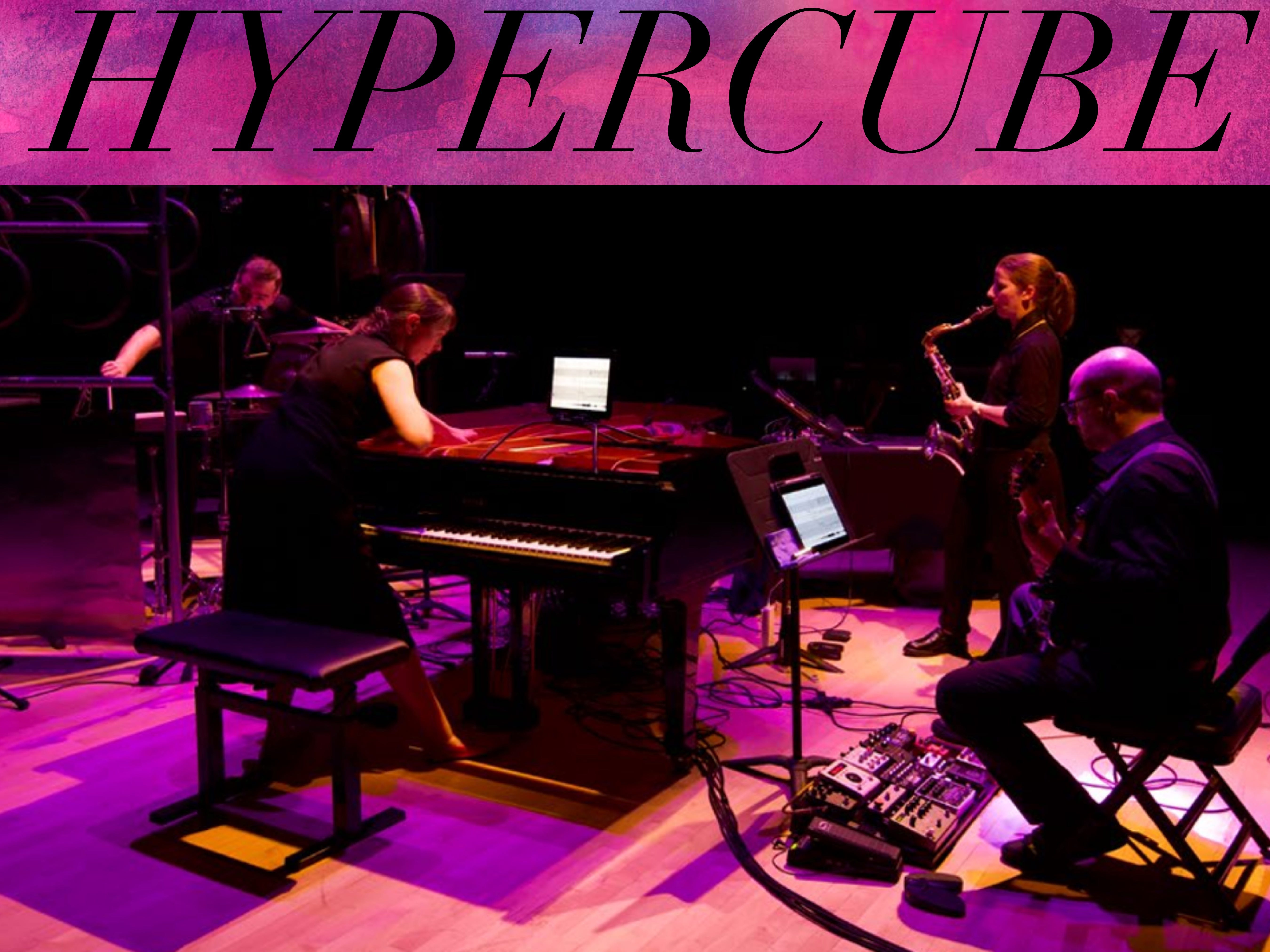
While they released their debut in 2020, I first connected with Hypercube, the mixed ensemble of Erin Rogers, saxophone; Andrea Lodge, keyboards; Jay Sorce, electric guitar; and Christopher Graham, percussion, through their work on Music For Billionaires, the 2023 album by Doug Bielmeier, whom I praised as “one of the brightest lights in the electroacoustic music sphere.” Then came The Force For Good, the 2025 EP that included Hout, the 1991 Louis Andriessen piece that inspired Hypercube’s instrumentation, which they played with a command that was “beyond reproach.”
But I think it’s on Trace, which features five new compositions created in collaboration with Marcel Castro Lima, Seong Ae Kim, Corie Rose Soumah, Farzia Fallah, and Rudig, that Hypercube have truly come into their own. Each piece not only has a very unique approach and sound world, but it also feels like the players are putting more of their own personalities into the recordings.
Speaker For The Dead is a perfect example of what Hypercube has accomplished here. Rogers opens the piece with low notes, like a foghorn announcing a vessel approaching from an unknown land. Soon, she’s duetting with Lodge’s SK-1, presenting a distorted reflection of her sound. Sorce (who really should change his name to “scorch”) enters, his guitar shrouded in fuzz and barely controlled feedback, slipping malevolently into the environment before taking over with a short solo. A new section begins, with rattling percussion from Graham, high squeals from Rogers, and more shards from Sorce.
The last third of the piece hints at Gamelan at first, before the guitar and the SK-1 begin duking it out in a battle that brings to mind Kong vs. Godzilla. In this video of a 2023 performance by Hypercube, you can see Lodge grabbing some sound from Sorce’s guitar before entering the ring, so to speak. The fight is drawn, and after a momentary pause, we get a coda featuring a merry chase between percussion and the SK-1’s 40-year-old sampling chip before the scene fades to black. In Speaker For The Dead, Rudig resurrects the Casio and gives it a new life beyond my wildest dreams.
Another highlight on the album is the recording of Soumah’s SPINNING, TOUCHED, UNDREAMT; SNOW-, which I heard at the MATA Festival in 2023. In that incarnation, I noted that “each instrument had its own agenda, with any joint efforts coming off as happenstance.” Not so in Hypercube’s take, which reveals a group effort of extraordinary focus. And so it goes on all of Trace, a no-skips album if there ever was one!
Trace is not available on Spotify, but you can hear most of the other songs for Friday here or below.
Also Out Today
The Strokes - Reality Awaits (Cult/RCA) While I called their last album, 2020’s The New Abnormal, “A triumph for the band and for producer Rick Rubin,” it did not make the cut for the Top 25 that year. Competition was fierce, for sure, but I also think they were playing it a little safe. With six years in between albums, it would be hard to credit momentum for what we hear on Reality Awaits, but there’s no doubt that it’s outrageously good (and often just outrageous), and their best since Angles. Even though it seems awkward to have a knee-jerk reaction while stuck in the mud, those who have convinced themselves that autotune is “wrong,” should at least try to pretend it can be “right” and allow themselves to hear the music in Casablancas’ vocal approach, which pushes the technology hard.
Of course, Casablancas’ altered voice is but one sonic texture on this varied nine-track album. The twin guitars of guitarists Nick Valensi and Albert Hammond Jr. continue to find new ways to interact and intertwine, sometimes joined by Nikolai Fraiture’s bass, which can morph from melodic to propulsive at will. Drummer Fabrizio Moretti is a master of time and space, never playing an excess note. As the band moves ever closer to art rock, there are also some rich keyboard textures textures in the mix. Rick Rubin’s production throughout is crystal clear and dynamic.
The album opens with Psycho Shit, which has the feel of an overture, rising out of nowhere, ascending to increasingly hysterical heights, and returning to earth on a bed of shimmering and arpeggiated guitars. Dine N’Dash picks up the tempo, a moody rocker with a nagging undercurrent. Casablancas begins the song in a conversational tone, soon moving to a Bowie-esque tone in the second verse before intoning the bridge: “Permission to speak?/Permission to launch?/Permission to sit?/Permission to die?”
Lonely In The Future opens like a heatseeking missile before transitioning into a self-consciously “Strokesian” jangle as appropriate for a tongue-lashing of all the doubters and ripoff artists the band has had to put up with over the last nearly three decades: “I did that yesterday,/Oh I did that years ago when I was a kid/I didn't want to do it yesterday, but I did I did that yesterday when I was a kid,” he sings on the chorus, later taking a well-timed swipe at Anthony Fantano. Even fans of the band are likely not ready for the very exaggerated bridge, which has Casablancas playing the autotune like a squiggly Jan Hammer solo on an old fusion record. But anyone can get behind the elegiac solo Valensi delivers to end the song. The second single from the album, Falling Out Of Love, a dreamy disquieting ballad, has found its true home as an album cut.
Chugging guitars, cloudy keyboards, and a sing along chorus distinguish Going To Babble On, which has been reworked from its original incarnation as Starting Again, which was used as the soundtrack for a political ad in 2021. It goes out on a gloriously baroque guitar solo that could go on for ever, as far as I’m concerned. Instead the song abruptly ends, providing the perfect lead-in to Going Shopping, a song that sounded like a instant classic when I heard it on a Coachella livestream. The breezy feel is in complete opposition to how highly crafted it is as a song and recording, and that tension is divine.
The album’s last three songs may be the most radical of all, from the elegant suspension of Liar’s Remorse and the near-funk of The Fruits Of Conquest (conga drums on a Strokes album? Say what?), to Tyrants Of The Mellow Moon, where Casablancas seems to be audibly shedding the skin of his diction, trying to escape himself as Moretti plays a loose shuffle and the guitars chime away.
It ain’t for everyone, but what truly great music is? For those who question what The Strokes are up to, reality awaits in the form of this masterpiece.
Hypercube is *amazing* – such versatility and confidence!